

Skip to content
Explore the technologies shaping modern life through clear, engaging coverage of gadgets, software, artificial intelligence, cybersecurity, mobile devices, apps, and digital innovation. Our technology content explains important developments, examines emerging trends, and provides practical insights that help readers better understand the tools, platforms, and ideas transforming the digital world today. Find What You Need See What’s Available Check What’s Available Explore What’s Available Discover What’s Available See How It Works Learn How It Works Discover How It Works Find Out How See How Learn More About It Find Out More About It Discover More About It Explore More About It Read More About It Get the Details Get Full Details Get the Full Story View the Full Story Discover the Full Story Explore the Full Story Find the Full Story Learn More Now Find Out Now Read More Now View More Now See More Now Get Started Now Start Exploring Start Discovering Start Learning Explore Here Discover Here Read It Here See It Here View It Here Check It Here Find It Here Go Here Visit Here Click to Explore Click to Discover Click to Read More Click to View Click to See More Click for Details Click for More Information Tap to Learn More Tap to Explore Tap to Discover Take Me There Show Me More Tell Me More Show Me the Details See the Benefits Discover the Benefits Explore the Benefits Find Out Why See Why Discover Why
Skip to content
YukonBlondeStream.com

YukonBlondeStream.com

Subscribe
  • Free Slots
  • High-RTP
  • Jackpot Slots
  • Megaways Slots
  • Mobile Slots
  • Slot Guides

Home › Slot Providers

Category: Slot Providers

Push Gaming Slots: Features and Game Design Explained

Push Gaming Slots: Features and Game Design Explained

Javier Domínguez09/19/202609/19/2026

Some slot developers build dozens of games around nearly identical reel structures. Push Gaming tends to take a different route, often giving each release one recognizable mechanic that shapes the theme, animations, and bonus structure around it.

Push Gaming Slots range from cascading cluster games and mystery-symbol slots to collection features, instant prizes, expanding grids, and multiplier-heavy bonuses.

Games such as Jammin’ Jars, Razor Shark, Wild Swarm, and Big Bamboo demonstrate how the studio repeatedly combines relatively simple core ideas with progression systems that become more interesting as a round develops.

Push Gaming Designs Around a Main Mechanic

A useful way to understand Push Gaming’s catalogue is to look for the central mechanic in each title.

The company describes its approach as player-focused and emphasizes distinctive features, strong art, and games designed to work across mobile devices. Its website also highlights portrait-mode design as an important part of the experience.

That design philosophy is visible in individual titles.

Jammin’ Jars revolves around moving Wild Jar symbols and accumulating multipliers.

Razor Shark focuses on Mystery Stacks and its Razor Reveal mechanic.

Wild Swarm builds tension through a Hive meter and collectible bees.

Big Bamboo centers much of its gameplay around Mystery Bamboo symbols and the Golden Bamboo feature.

Instead of adding features randomly, the theme and interface usually support one recognizable idea.

That makes individual releases easier to identify even when their mathematical structures are very diferent.

Jammin’ Jars Shows the Cluster-and-Cascade Style

Jammin’ Jars is one of Push Gaming’s clearest examples of grid-based design.

The game uses an 8×8 layout and cascading Cluster Pays. Five or more matching fruits can produce a win, after which symbols cascade and the board can create another combination.

The Jam Jar symbol works as both a Wild and a Scatter.

Each Jar also carries a multiplier beginning at 1x. When the Jar contributes to a winning cluster, its multiplier applies to that win.

This creates an important progression effect.

The first cascade may be relatively simple, but repeated Jar participation can make later parts of the same sequence behave differently.

The game’s Free Games feature expands that concept by keeping Jam Jars active as they move around the grid.

Push Gaming described Jammin’ Jars at launch as a mobile-first cascading Cluster Pays title, showing that the combination of compact mobile presentation and repeated reactions was intentional from the beginning.

Mystery Symbols Create Suspense Before the Result

Mystery symbols appear frequently across Push Gaming’s portfolio.

Razor Shark is probably the best-known example.

The game uses a 5×4 layout with 20 paylines, but stacks of Mystery symbols can activate a nudge-and-reveal sequence. Golden Shark symbols can then trigger Razor Reveal, where Mystery positions become mini-reels containing multipliers of up to 2,500x as well as possible Scatters.

This design separates the initial reel result from the final outcome.

The symbols stop first.

Then the Mystery positions reveal what they actually contain.

That extra stage creates suspense without requiring the entire grid to transform.

Mystery Museum uses a related idea. Three or more Mystery Stacks can activate its Nudge & Reveal feature, while Mystery Stacks become sticky during Free Games and only reveal when there is an opportunity for a win.

The visual reveal is therefore part of the mechanic rather than just decoration.

Collection Meters Add Long-Term Progression

Another recurring design technique is to make symbols contribute toward a meter.

Wild Swarm uses collectible bees to build its Hive.

When enough progress is made, the game can enter Swarm Mode, where sticky Wild behavior becomes much more important. The original game also includes Free Games and a Chest feature containing potential prizes such as Free Spins, Swarm Boosts, or instant entry to Swarm Mode.

Wild Swarm 2 develops the concept further.

Worker Bees add one segment to the Hive meter while Queen Bees add five. Once the Hive reaches level five, qualifying Bee symbols may trigger Swarm Mode. The sequel also adds reel multipliers and more elaborate Sticky Wild interactions during its features.

This kind of progression changes the feel of the base game.

Not every symbol has to create an immediate cash payout to feel relevant.

Some symbols move a meter closer to a future feature, creating anticipation over multiple spins.

Big Bamboo Uses Layered Feature Reveals

Big Bamboo takes another route.

Its Mystery Stack symbols can reveal paying symbols, Wilds, or Golden Bamboo symbols. When Golden Bamboo appears, the game opens a special feature containing Instant Prizes, Collectors, Multipliers, Scatters, and other modifiers.

Free Spins add another layer through symbol conversions.

Lower-value symbols can gradually be converted into Bamboo symbols, changing the composition of the reels during the feature.

Big Bamboo 2 expands the same design philosophy.

Its Free Spins progression collects Bonus and Extra Spin symbols through a Low Symbol Meter.

Advancing levels removes low symbols, grants additional Free Spins, and changes the reel environment, while Golden Bamboo positions can create persistent frames that remain for the feature.

This illustrates one of Push Gaming’s most consistant design habits: a bonus often becomes more developed as it continues rather than simply repeating ten identical free spins.

Multipliers Are Often Connected to Something Visual

Multipliers in these games are rarely just an unexplained number beside the reels.

They are usually connected to a visible object or progression mechanic.

Jammin’ Jars attaches multipliers directly to its Jar Wilds.

Razor Shark places potential multipliers inside Mystery mini-reels.

Wild Swarm 2 uses dedicated reel multipliers during Free Spins and Swarm Mode. Filling a reel with Sticky Wilds can apply those multipliers to the symbols below.

Mad Cars turns Instant Prize Car symbols into moving bet multipliers. The cars climb toward the top of the reels, while a Boost Reel can increase their values or move them farther toward the finish line.

This visual connection helps explain the mathematics.

Instead of simply displaying “20x,” the game gives players something to watch develop before the multiplier is collected.

Push Gaming Experiments Beyond Standard Paylines

The portfolio is not tied to one reel system.

Razor Shark uses 20 paylines, while Jammin’ Jars uses Cluster Pays. Newer games can use dynamic ways systems and expanding layouts.

Razor Ways, for example, begins with three active rows and three locked rows. Cascades or Instant Prize wins can unlock additional rows, eventually creating up to 46,656 ways to pay. Expanding Wild symbols can then cover unlocked rows and carry multipliers.

Push Gaming also promotes proprietary systems including Push Ways, Push Pots, and Cluster Link.

Push Ways can use Hot Zones that split symbols and create additional ways to win, while Push Pots gives individual pots different game-changing abilities. Cluster Link triggers instant wins when enough prizes form qualifying clusters.

This variety means the provider name alone does not tell you how a game calculates wins.

The paytable still matters.

High Volatility Appears Frequently

Many well-known Push Gaming releases are classified as High volatility.

Jammin’ Jars, Razor Shark, Big Bamboo, Mad Cars, and Big Bamboo 2 all carry High volatility labels on their official game pages.

Wild Swarm is listed as Mid-High rather than High, showing that not every game uses exactly the same profile.

Volatility should therefore be checked individually.

The same applies to RTP.

Push Gaming explicitly notes on its game pages that available RTP can vary by casino or market, and the specific RTP can be seen within the game’s user panel or loading screen.

That is more reliable than assuming one RTP figure applies to every version online.

Bonus Buy Is Available on Selected Games

Several Push Gaming titles list Bonus Buy as available, including Jammin’ Jars, Fat Rabbit, Big Bamboo, and Mad Cars.

Bonus Buy changes access to a feature rather than guaranteeing a profitable result.

Regional availability can also vary, so a feature shown on the developer’s page may not appear through every operator.

Push Gaming also offers Push Bet, a mechanic described as increasing the likelihood of triggering special features or Bonus Games.

These systems can change the cost and pacing of play, so their rules should be read seperately from the core slot mechanics.

Push Gaming Slots stand out through feature-led design rather than one universal reel formula.

Jammin’ Jars uses clusters and Wild multipliers, Razor Shark emphasizes Mystery reveals, Wild Swarm builds collection progression, and Big Bamboo layers multiple bonus systems together.

Before playing, explore the paytable and check the exact volatility, RTP version, Bonus Buy availability, and feature rules for that specific game.

NetEnt Slots Guide: Classic Mechanics and New Ideas

NetEnt Slots Guide: Classic Mechanics and New Ideas

Javier Domínguez08/18/202608/05/2026

Some slot providers become associated with one particular style. NetEnt is harder to place in a single category because its games range from simple payline titles to branded adventures and expanding grid releases.

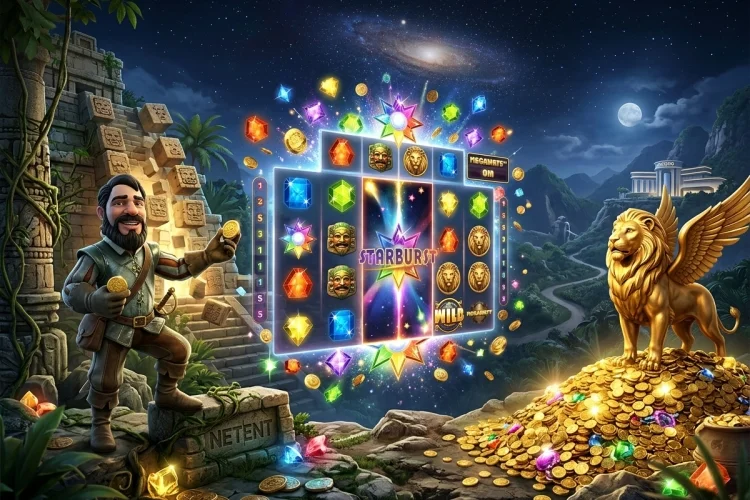
The appeal of NetEnt Slots often comes from a recognizable central mechanic. Starburst has expanding wilds, Gonzo’s Quest has Avalanche wins, Twin Spin has synchronized reels, and Divine Fortune uses falling wilds and jackpots.

Newer versions then expand those original ideas with more reels, selectable features, or higher maximum prizes. Understanding these mechanics makes it easier to compare the classics with their modern updates.

Fixed Paylines Keep the Rules Familiar

Traditional payline games award prizes when matching symbols appear across predefined patterns. This format is usually easy to follow because the paytable shows the exact lines used.

Starburst uses ten paylines, while Divine Fortune uses 20. The first emphasizes expanding wilds and respins, while the second combines its fixed-line structure with free spins, falling wilds, and jackpot features.

These games show that a familiar reel format can still support very different levels of complexity.

Twin Reels Created a Recognizable Feature

The Twin Spin series is built around adjacent reels that synchronize and display identical symbols. The mechanic can increase the number of matching icons shown on the grid without requiring a separate bonus round.

Twin Spin XXXtreme modernizes the concept with six reels, 729 ways to win, random multipliers, and optional XXXtreme Spins. Depending on the selected option, the feature can guarantee at least three or four synchronized reels.

The newer version keeps the original identity while adding a more aggressive feature-driven structure.

Avalanche Wins Connect Multiple Results

Gonzo’s Quest replaces normal reel spins with falling blocks. After a winning combination, the matching symbols disappear and new ones fall into place.

The Avalanche sequence can continue as long as new wins form. Multipliers grow during consecutive wins, while the Free Falls round increases their potential further.

This creates a different rhythm from fixed-payline games because one starting round can lead to several linked combinations.

Cluster Pays Uses Connected Symbols

Aloha! Cluster Pays moved away from paylines by awarding prizes for groups of matching symbols that touch each other. NetEnt described it as the first game in its portfolio to use this mechanic.

Cluster systems make the shape and position of a symbol group more important than its placement on a traditional line. They also work well with larger grids and mechanics that remove or transform winning icons.

For players familiar only with paylines, checking the minimum cluster size is an important first step.

Branded Games Add Interactive Bonuses

NetEnt has also produced games based on recognizable entertainment properties. Jumanji is a strong example because its design goes beyond replacing ordinary symbols with film characters.

The game uses a 3-4-5-4-3 layout, four random modifiers, and a board-game bonus controlled by dice rolls. The board can award different Free Spins modes, coin prizes, or additional movement.

This creates a more interactive experience, although it also requires a longer explanation than a simple five-reel slot.

Jackpots Form Another Major Style

Divine Fortune combines regular slot features with three jackpot prizes. Its Wild on Wild system can create expanding symbols and falling-wild respins in both the main game and Free Spins.

Later versions change the formula significantly. Divine Fortune Megaways uses six reels, changing symbol counts, and up to 117,649 winning ways while retaining falling wilds and free spins.

Divine Fortune Gold, released in 2026, adds cash-prize collection, several bonus modes, an Elevate feature, and a progressive Mega Jackpot.

Classic Names Do Not Mean Identical Games

A sequel may share characters and artwork with an original title while changing the grid, RTP, volatility, and maximum payout.

For example, Starburst XXXtreme keeps the cosmic theme but adds random wilds, feature-buy options, high volatility, and a listed maximum of 16,800x. The original Starburst has a much simpler structure and an 800x maximum.

Always read the full game title instead of assuming that every version follows the original rules.

The variety of NetEnt Slots comes from their mechanics as much as their themes. Fixed paylines offer familiar rules, Twin Reels synchronize symbols, Avalanche systems connect several wins, and cluster games replace lines with groups of matching icons.

Branded games and jackpot titles add board bonuses, progressive prizes, modifiers, and feature choices. Modern sequels often preserve one famous idea while rebuilding almost everything around it.

Before playing, identify the win system and check the bonus rules, RTP, volatility, and maximum payout. Try several demos and decide whether you prefer a focused classic or a more complex modern adaptation.

Slot Provider Trustworthy Checklist: What Should You Verify?

Slot Provider Trustworthy Checklist: What Should You Verify?

Javier Domínguez08/13/202608/05/2026

Online slot providers often describe themselves as secure, innovative, and trusted. Those words sound reassuring, but they are still marketing claims until you can connect them to verifiable evidence.

A practical Slot Provider Trustworthy checklist helps you examine the company systematically.

Instead of judging a studio by its logo or biggest game, you can investigate its legal identity, licences, laboratory testing, mathematical transparency, software quality, and history in regulated markets.

This approach is useful for players, casino reviewers, and affiliate publishers who want to avoid recommending suppliers based entirely on popularity.

Verify the Company’s Identity

Start with the legal company name rather than the brand name alone. A provider may operate several studios, subsidiaries, or regional companies.

Check the address, corporate information, support channels, and names appearing on official regulatory records. Be cautious when the company provides no legal identity or uses copied contact information.

A professional website should also publish clear terms, privacy information, and details about the markets in which its software is available.

Search Official Licence Registers

Do not rely on a licence logo placed at the bottom of a provider’s website. Logos can be outdated, used incorrectly, or copied.

Use the regulator’s official register or authorization page to confirm the company name, licence number, licence type, and current status.

The Malta Gaming Authority, for example, distinguishes its B2B Critical Gaming Supply licence from licences issued directly to consumer-facing gambling operators.

Record the jurisdiction checked because licences are not universal.

Look for Recognized Testing Laboratories

A trustworthy supplier should be able to identify how its games and RNG systems are assessed. Recognized testing laboratories evaluate areas that ordinary players cannot verify through casual gameplay.

GLI states that its game-mathematics analysis may evaluate every possible combination or run large simulations to calculate theoretical RTP.

The UK Gambling Commission also maintains approved test-house procedures for relevant third-party testing. The test scope must be sufficient to assess compliance with regulatory standards.

A vague “certified fair” badge without a laboratory name or certificate context is much less useful.

Examine RTP and Volatility Disclosure

Open several games from the provider and check whether their RTP, volatility, paytable, stake range, and maximum win are clearly displayed.

The same title may sometimes be distributed in different mathematical configurations. A responsible supplier makes the exact version understandable rather than displaying one promotional figure that may not apply everywhere.

RTP should be described as a long-term theoretical calculation. Volatility should explain the general distribution of outcomes, not promise a particular pattern within one session.

Test More Than One Game

One polished release does not prove that the whole catalogue is reliable. Test several titles from different years and product categories.

Check loading time, animation smoothness, paytable readability, touch controls, screen rotation, and recovery after a connection interruption. Use the same phone or computer so the comparison remains consistent.

Technical quality should be reasonably stable. Repeated crashes, unreadable rules, or missing result information across several titles can indicate weak quality control.

Review How Results Are Communicated

A game should show the stake, payout, and final balance clearly. It should not use celebration effects to make a partial return appear more valuable than it really is.

British responsible-design requirements state that slots must not celebrate returns equal to or below the total stake.

Also check whether bonus purchases, multipliers, and maximum-win conditions are explained plainly. Complicated mechanics require more transparency, not less.

Check Security and Release Practices

Players rarely see the provider’s full internal security process, but there are external signals. Regulated software companies may operate within frameworks that require technical testing, controlled updates, and independent security review.

The UK Gambling Commission’s testing strategy covers games, software updates, live RTP monitoring, development practices, and annual security audits.

Providers that openly discuss testing, certifications, and regulated partnerships offer more evidence than companies making unsupported security claims.

Watch for Common Red Flags

Be cautious when the provider has no verifiable licence, hides RTP information, uses unknown testing badges, or makes claims of guaranteed wins.

Other warning signs include copied game artwork, broken support links, unexplained changes to rules, and pressure to install unofficial software.

A trustworthy studio does not need to promise easy profits. Its credibility should come from transparent rules, tested products, and accountable business practices.

A Slot Provider Trustworthy checklist should cover legal identity, active licensing, independent testing, RTP disclosure, game quality, responsible design, and security practices.

No individual feature provides complete proof, but several verified signals can create a stronger overall picture.

Use official regulator databases rather than relying on website badges, and review multiple games under similar conditions. Pay close attention to vague certifications and missing mathematical information.

Before publishing a recommendation or using a provider’s games, document the licence, test laboratory, RTP source, and technical observations so your decision is based on evidence rather than brand recognition.

Spotlight

  • Best Types of Free Slots for Learning the BasicsBest Types of Free Slots for Learning the Basics
  • What Happens After a Progressive Jackpot Is Won? A Simple GuideWhat Happens After a Progressive Jackpot Is Won? A Simple Guide
  • Virtual Credit Systems in Free Slot Modes: How Demo Balances WorkVirtual Credit Systems in Free Slot Modes: How Demo Balances Work
  • Progressive Jackpot Systems: How Seed Values Shape Every ResetProgressive Jackpot Systems: How Seed Values Shape Every Reset

Latest Updates

  • Push Gaming Slots: Features and Game Design ExplainedPush Gaming Slots: Features and Game Design Explained
  • Cluster Pays vs Cascading Reels: What Is the Difference?Cluster Pays vs Cascading Reels: What Is the Difference?
  • iPhone Slots Guide: Safari, Apps and Compatibility ExplainediPhone Slots Guide: Safari, Apps and Compatibility Explained
  • Best Types of Free Slots for Learning the BasicsBest Types of Free Slots for Learning the Basics

Web Network

  • Ronpaul Explore
  • Slot Online
  • Slot Gacor
  • Slot88
  • Demo Slot
  • Game Online
  • Situs Slot
  • Slot Gacor Online
  • Slot88 Login
  • Akun Demo Slot
  • About Us
  • Contact
  • Disclaimer
  • Privacy Policy
  • Terms & Conditions
© 2026 YukonBlondeStream.com | Theme: BlockWP by Candid Themes.