
Some slot developers build dozens of games around nearly identical reel structures. Push Gaming tends to take a different route, often giving each release one recognizable mechanic that shapes the theme, animations, and bonus structure around it.
Push Gaming Slots range from cascading cluster games and mystery-symbol slots to collection features, instant prizes, expanding grids, and multiplier-heavy bonuses.
Games such as Jammin’ Jars, Razor Shark, Wild Swarm, and Big Bamboo demonstrate how the studio repeatedly combines relatively simple core ideas with progression systems that become more interesting as a round develops.
Push Gaming Designs Around a Main Mechanic
A useful way to understand Push Gaming’s catalogue is to look for the central mechanic in each title.
The company describes its approach as player-focused and emphasizes distinctive features, strong art, and games designed to work across mobile devices. Its website also highlights portrait-mode design as an important part of the experience.
That design philosophy is visible in individual titles.
Jammin’ Jars revolves around moving Wild Jar symbols and accumulating multipliers.
Razor Shark focuses on Mystery Stacks and its Razor Reveal mechanic.
Wild Swarm builds tension through a Hive meter and collectible bees.
Big Bamboo centers much of its gameplay around Mystery Bamboo symbols and the Golden Bamboo feature.
Instead of adding features randomly, the theme and interface usually support one recognizable idea.
That makes individual releases easier to identify even when their mathematical structures are very diferent.
Jammin’ Jars Shows the Cluster-and-Cascade Style
Jammin’ Jars is one of Push Gaming’s clearest examples of grid-based design.
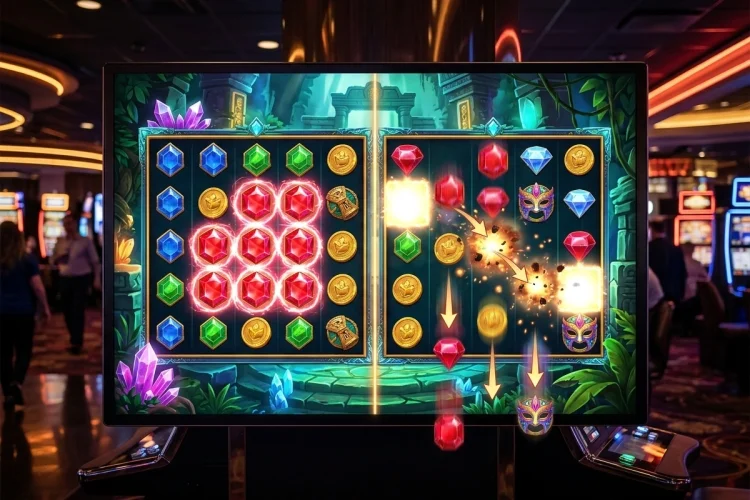
The game uses an 8×8 layout and cascading Cluster Pays. Five or more matching fruits can produce a win, after which symbols cascade and the board can create another combination.
The Jam Jar symbol works as both a Wild and a Scatter.
Each Jar also carries a multiplier beginning at 1x. When the Jar contributes to a winning cluster, its multiplier applies to that win.
This creates an important progression effect.
The first cascade may be relatively simple, but repeated Jar participation can make later parts of the same sequence behave differently.
The game’s Free Games feature expands that concept by keeping Jam Jars active as they move around the grid.
Push Gaming described Jammin’ Jars at launch as a mobile-first cascading Cluster Pays title, showing that the combination of compact mobile presentation and repeated reactions was intentional from the beginning.
Mystery Symbols Create Suspense Before the Result
Mystery symbols appear frequently across Push Gaming’s portfolio.
Razor Shark is probably the best-known example.
The game uses a 5×4 layout with 20 paylines, but stacks of Mystery symbols can activate a nudge-and-reveal sequence. Golden Shark symbols can then trigger Razor Reveal, where Mystery positions become mini-reels containing multipliers of up to 2,500x as well as possible Scatters.
This design separates the initial reel result from the final outcome.
The symbols stop first.
Then the Mystery positions reveal what they actually contain.
That extra stage creates suspense without requiring the entire grid to transform.
Mystery Museum uses a related idea. Three or more Mystery Stacks can activate its Nudge & Reveal feature, while Mystery Stacks become sticky during Free Games and only reveal when there is an opportunity for a win.
The visual reveal is therefore part of the mechanic rather than just decoration.
Collection Meters Add Long-Term Progression
Another recurring design technique is to make symbols contribute toward a meter.
Wild Swarm uses collectible bees to build its Hive.
When enough progress is made, the game can enter Swarm Mode, where sticky Wild behavior becomes much more important. The original game also includes Free Games and a Chest feature containing potential prizes such as Free Spins, Swarm Boosts, or instant entry to Swarm Mode.
Wild Swarm 2 develops the concept further.
Worker Bees add one segment to the Hive meter while Queen Bees add five. Once the Hive reaches level five, qualifying Bee symbols may trigger Swarm Mode. The sequel also adds reel multipliers and more elaborate Sticky Wild interactions during its features.
This kind of progression changes the feel of the base game.
Not every symbol has to create an immediate cash payout to feel relevant.
Some symbols move a meter closer to a future feature, creating anticipation over multiple spins.
Big Bamboo Uses Layered Feature Reveals
Big Bamboo takes another route.
Its Mystery Stack symbols can reveal paying symbols, Wilds, or Golden Bamboo symbols. When Golden Bamboo appears, the game opens a special feature containing Instant Prizes, Collectors, Multipliers, Scatters, and other modifiers.
Free Spins add another layer through symbol conversions.
Lower-value symbols can gradually be converted into Bamboo symbols, changing the composition of the reels during the feature.
Big Bamboo 2 expands the same design philosophy.
Its Free Spins progression collects Bonus and Extra Spin symbols through a Low Symbol Meter.
Advancing levels removes low symbols, grants additional Free Spins, and changes the reel environment, while Golden Bamboo positions can create persistent frames that remain for the feature.
This illustrates one of Push Gaming’s most consistant design habits: a bonus often becomes more developed as it continues rather than simply repeating ten identical free spins.
Multipliers Are Often Connected to Something Visual
Multipliers in these games are rarely just an unexplained number beside the reels.
They are usually connected to a visible object or progression mechanic.
Jammin’ Jars attaches multipliers directly to its Jar Wilds.
Razor Shark places potential multipliers inside Mystery mini-reels.
Wild Swarm 2 uses dedicated reel multipliers during Free Spins and Swarm Mode. Filling a reel with Sticky Wilds can apply those multipliers to the symbols below.
Mad Cars turns Instant Prize Car symbols into moving bet multipliers. The cars climb toward the top of the reels, while a Boost Reel can increase their values or move them farther toward the finish line.
This visual connection helps explain the mathematics.
Instead of simply displaying “20x,” the game gives players something to watch develop before the multiplier is collected.
Push Gaming Experiments Beyond Standard Paylines
The portfolio is not tied to one reel system.
Razor Shark uses 20 paylines, while Jammin’ Jars uses Cluster Pays. Newer games can use dynamic ways systems and expanding layouts.
Razor Ways, for example, begins with three active rows and three locked rows. Cascades or Instant Prize wins can unlock additional rows, eventually creating up to 46,656 ways to pay. Expanding Wild symbols can then cover unlocked rows and carry multipliers.
Push Gaming also promotes proprietary systems including Push Ways, Push Pots, and Cluster Link.
Push Ways can use Hot Zones that split symbols and create additional ways to win, while Push Pots gives individual pots different game-changing abilities. Cluster Link triggers instant wins when enough prizes form qualifying clusters.
This variety means the provider name alone does not tell you how a game calculates wins.
The paytable still matters.
High Volatility Appears Frequently
Many well-known Push Gaming releases are classified as High volatility.
Jammin’ Jars, Razor Shark, Big Bamboo, Mad Cars, and Big Bamboo 2 all carry High volatility labels on their official game pages.
Wild Swarm is listed as Mid-High rather than High, showing that not every game uses exactly the same profile.
Volatility should therefore be checked individually.
The same applies to RTP.
Push Gaming explicitly notes on its game pages that available RTP can vary by casino or market, and the specific RTP can be seen within the game’s user panel or loading screen.
That is more reliable than assuming one RTP figure applies to every version online.
Bonus Buy Is Available on Selected Games
Several Push Gaming titles list Bonus Buy as available, including Jammin’ Jars, Fat Rabbit, Big Bamboo, and Mad Cars.
Bonus Buy changes access to a feature rather than guaranteeing a profitable result.
Regional availability can also vary, so a feature shown on the developer’s page may not appear through every operator.
Push Gaming also offers Push Bet, a mechanic described as increasing the likelihood of triggering special features or Bonus Games.
These systems can change the cost and pacing of play, so their rules should be read seperately from the core slot mechanics.
Push Gaming Slots stand out through feature-led design rather than one universal reel formula.
Jammin’ Jars uses clusters and Wild multipliers, Razor Shark emphasizes Mystery reveals, Wild Swarm builds collection progression, and Big Bamboo layers multiple bonus systems together.
Before playing, explore the paytable and check the exact volatility, RTP version, Bonus Buy availability, and feature rules for that specific game.