
Skip to content
Explore the technologies shaping modern life through clear, engaging coverage of gadgets, software, artificial intelligence, cybersecurity, mobile devices, apps, and digital innovation. Our technology content explains important developments, examines emerging trends, and provides practical insights that help readers better understand the tools, platforms, and ideas transforming the digital world today. Find What You Need See What’s Available Check What’s Available Explore What’s Available Discover What’s Available See How It Works Learn How It Works Discover How It Works Find Out How See How Learn More About It Find Out More About It Discover More About It Explore More About It Read More About It Get the Details Get Full Details Get the Full Story View the Full Story Discover the Full Story Explore the Full Story Find the Full Story Learn More Now Find Out Now Read More Now View More Now See More Now Get Started Now Start Exploring Start Discovering Start Learning Explore Here Discover Here Read It Here See It Here View It Here Check It Here Find It Here Go Here Visit Here Click to Explore Click to Discover Click to Read More Click to View Click to See More Click for Details Click for More Information Tap to Learn More Tap to Explore Tap to Discover Take Me There Show Me More Tell Me More Show Me the Details See the Benefits Discover the Benefits Explore the Benefits Find Out Why See Why Discover Why
Skip to content
YukonBlondeStream.com

YukonBlondeStream.com

Subscribe
  • Free Slots
  • High-RTP
  • Jackpot Slots
  • Megaways Slots
  • Mobile Slots
  • Slot Guides

Home › Slot Reviews

Category: Slot Reviews

Cluster Pays vs Cascading Reels: What Is the Difference?

Cluster Pays vs Cascading Reels: What Is the Difference?

Javier Domínguez09/15/202609/19/2026

Modern slot games do not always rely on traditional paylines. Some ask you to build groups of matching symbols, while others remove winning icons and drop fresh ones into the empty spaces.

Because these features often appear together, it is easy to assume they are the same thing. The Cluster Pays vs Cascading Reels comparison is actually straightforward.

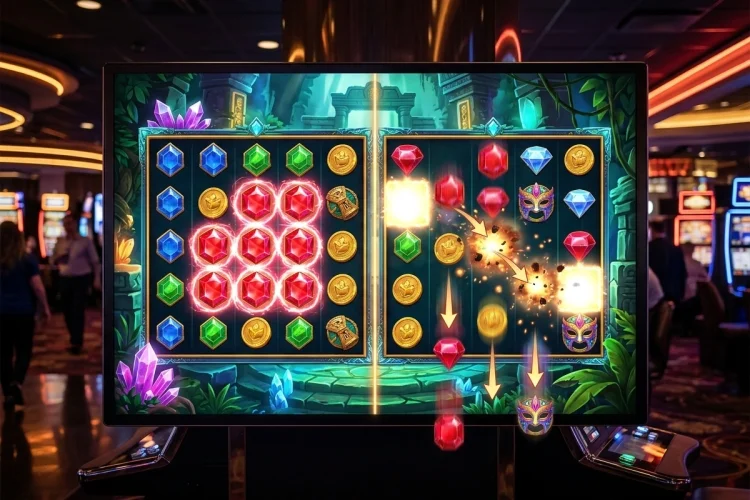
Cluster Pays describes how a winning combination is formed, while Cascading Reels describes what happens after certain wins occur. A slot can use one without the other, or combine both to create repeated reactions from a single paid spin.

What Is Cluster Pays?

Cluster Pays is a winning system based on groups of matching symbols.

Instead of matching symbols across a fixed horizontal or diagonal line, you normally need several identical symbols touching one another on a grid.

Horizontal and vertical connections are the most common rules.

Evolution’s Funk Master, for example, uses NetEnt’s Cluster Pays mechanic. Five or more matching symbols connected horizontally or vertically form a winning cluster.

This changes how you read the screen.

In a traditional payline slot, you tend to scan from left to right.

In a cluster game, you look across the entire grid for connected groups.

Imagine five matching fruit symbols forming an L shape. If the rules count horizontal and vertical connections, that irregular shape may still qualify as one cluster.

The precise minimum cluster size varies from game to game.

What Are Cascading Reels?

Cascading Reels are different because they are not primarily a payout pattern.

They describe a sequence that happens after a qualifying win.

Once a winning combination is paid, the symbols involved are removed. Symbols above them fall into the empty spaces, and new icons enter the grid.

If another winning combination appears, another cascade can begin.

NetEnt calls its version Avalanche. In Gonzo’s Quest, winning symbols on paylines disappear and are replaced by new symbols falling into their positions.

Other developers use names such as tumble, reaction, cascade, or drop.

The terminology changes, but the basic idea is similar.

One paid spin can potentially generate several sequential results before no new win remains.

The Biggest Difference Is Win Formation vs Win Continuation

This is the easiest way to remember the distinction.

Cluster Pays tells the game what counts as a win.

Cascading Reels tell the game what happens after that win.

Suppose a 7×7 grid requires five matching symbols to touch.

That is the Cluster Pays rule.

Now suppose those five symbols disappear after payout and new symbols fall into their spaces.

That is the cascading rule.

They are seperate systems even though they interact closely.

This distinction is important because many modern slots package both mechanics together, making them appear like one feature.

Once you separate them mentally, the paytable becomes much easier to understand.

Cluster Pays Can Work With Cascades

Sugar Rush is a clear example of the two mechanics working together.

Pragmatic Play describes the game as using a 7×7 grid where five or more matching symbols connected horizontally or vertically create a winning cluster. Those winning symbols then disappear through the tumble feature, allowing new symbols to fall into place.

Sugar Rush 1000 follows the same basic structure while adding stronger multiplier spots. Pragmatic Play specifically describes it as combining cluster pays with tumbling gameplay.

So one mechanic determines whether the cluster qualifies.

The second mechanic continues the action afterward.

This combination is popular because clusters can create irregular empty spaces across a large grid, giving replacement symbols many opportunities to form another group.

Cascading Reels Do Not Require Cluster Pays

This is where the difference becomes especially clear.

Gonzo’s Quest uses traditional paylines rather than Cluster Pays.

It has a five-reel, three-row layout with 20 paylines, yet it also uses the Avalanche cascading mechanic. Winning payline symbols disappear and new ones fall into their spaces.

Bonanza offers another example.

Big Time Gaming combines its Megaways system with Dual Reaction, a cascading reel feature. The game can create up to 117,649 ways to win, but its wins are not based on connected clusters.

That proves cascades are independent from Cluster Pays.

They can work with paylines, ways-to-win systems, Megaways, or grid-based cluster games.

The cascade simply needs a rule telling it which symbols should be removed after a win.

Cluster Pays Changes How You Read the Grid

Traditional slots train players to look for repeated symbols across reels.

Cluster games require a different visual habit.

Imagine a 7×7 board filled with candy symbols.

You may see three blue candies in one area and another two directly below them.

If all five are connected horizontally or vertically, they can form one cluster even though they do not sit on a straight line.

Cosmic Clusters uses a 6×6 grid where groups of five to fourteen matching symbols can create wins before triggering tumbles.

This structure makes the grid feel more like a puzzle board.

Diagonal symbols may look connected visually but often do not count unless the game rules specifically allow diagonal contact.

That is why reading the paytable is important before assuming how clusters form.

Cascades Can Create Multiple Wins From One Spin

The appeal of cascading mechanics is continuation.

A normal reel game may finish immediately after the reels stop and the payout is calculated.

A cascading game can continue changing after the initial result.

Suppose your first result produces a 4x payout.

The winning symbols disappear.

Replacement symbols create another 2x result.

Those symbols disappear too, followed by a third 5x combination.

The entire sequence began from one initial wager.

Some games also increase multipliers during those sequences.

Gonzo’s Quest, for example, increases its Avalanche multiplier as consecutive wins occur, up to the stated limits of the game.

That multiplier progression is an additional feature, not something every cascading slot automatically includes.

Cluster Games Often Use Large Grids

Cluster Pays tends to work naturally with larger grids.

A traditional 5×3 layout gives only fifteen symbol positions.

A 7×7 cluster grid contains forty-nine positions, giving connected symbols more room to form different shapes.

Pragmatic Play’s Candy Rush uses a 7×7 tumbling grid where clusters of five to fifteen or more matching symbols can create payouts.

Mining Rush also uses a 7×7 Cluster Pays format combined with tumbling wins.

However, grid size alone does not define Cluster Pays.

A game can use an unusual board shape or smaller layout as long as its payout rule is based on connected symbol groups.

Always check the actual mechanic rather than assuming any large grid must be a cluster game.

Cascades Can Interact With Wilds and Multipliers

Cascades often become the engine that powers additional mechanics.

A developer may add Wild symbols after each winning tumble, increase a multiplier, upgrade special symbols, or leave persistent modifiers behind.

Hot Pepper, for example, uses a 7×7 cluster grid where winning symbols disappear and new ones replace them. The game can also leave multiplier Wilds behind during tumbles.

Mystery Mice uses cluster wins and tumbles while special Power Wilds change as they participate in wins.

These features can make the cascade sequence much more important than the original result.

Still, remember that Wilds and multipliers are seperate mechanics again.

They are additions layered onto the cluster-and-cascade foundation.

Does One Mechanic Offer Better Odds?

Not automatically.

Cluster Pays does not guarantee more frequent wins simply because several symbols can connect in different shapes.

Cascading Reels also do not guarantee that every winning sequence will continue.

The game’s mathematical model determines symbol probability, RTP, volatility, payout values, bonus frequency, and maximum win.

Two cluster games can behave very differently.

Likewise, two cascading slots can have completely different risk profiles.

A busy screen with repeated explosions may feel more active, but visual activity should not be confused with better expected return.

Compare RTP and volatility seperately from the headline mechanic.

The core Cluster Pays vs Cascading Reels difference is simple: Cluster Pays determines how matching symbols form a winning group, while Cascading Reels remove winning symbols and replace them to create possible follow-up wins.

Many modern slots combine both, but neither mechanic requires the other. Check the paytable, cluster size, cascade rules, multipliers, and bonus features before playing.


Compare Two Online Slots with a Simple Scoring Framework

Compare Two Online Slots with a Simple Scoring Framework

Javier Domínguez08/08/202608/05/2026

Comparing two slot games can become surprisingly subjective. A reviewer may prefer one theme, enjoy a particular soundtrack, or give extra credit to the game that happened to produce the biggest demo win.

A scoring framework creates more consistency. When you Compare Two Online Slots using the same categories and weighting, readers can see exactly why one title received a stronger rating.

The score should not suggest that the higher-rated game is more likely to produce a profit. Instead, it should measure transparency, mechanics, presentation, usability, and overall entertainment design.

Here is a practical structure you can reuse across different slot comparisons.

Build the Framework Before Playing

Choose your categories before opening either game. This prevents you from changing the rules to favor the title you already prefer.

A possible framework could assign:

  • 25% to gameplay and mechanics
  • 20% to transparency and mathematical information
  • 15% to bonus features
  • 15% to presentation
  • 15% to technical performance
  • 10% to responsible design

The percentages can be adjusted for your publication, but they should remain identical for both games.

Score Mathematical Transparency

Check whether each title displays its RTP, volatility, stake limits, paytable, maximum win, and feature rules clearly.

RTP should be treated as a long-term theoretical percentage. A short test session cannot confirm or disprove the published figure, and previous wins or losses do not determine the next random outcome.

Award points for clarity and accessibility. Do not award points according to how much the test balance increased.

Rate the Main Gameplay

Examine how winning combinations form and whether the basic spin cycle remains understandable. Look at paylines, payways, clusters, cascades, symbol upgrades, or other central mechanics.

Ask whether the main system feels coherent. A complex game is not automatically superior to a simple one.

For example, a traditional 20-payline slot may appeal to readers who prefer familiar rules, while a pays-anywhere game can offer a busier grid and more varied combinations. Neither approach is universally better.

Judge Features by Their Execution

Review every important wild, scatter, free-spin round, multiplier, respin, or collection feature. Explain the trigger and what changes after activation.

Then score the quality rather than the number of features. Consider whether the rules are easy to understand, whether the mechanic connects naturally with the base game, and whether the interface communicates progress clearly.

A feature that looks impressive in marketing material may add little if it is confusing or disconnected from normal play.

Compare Maximum-Win Information

Record the maximum potential for each game and state whether it is expressed as a multiple of the stake.

Provider pages show how widely these limits can differ. Greedy Wolf advertises a maximum of 3,000x, while Zeus vs Hades lists 15,000x.

Do not automatically award the higher score to the larger number. Also evaluate how clearly the limit is disclosed and whether important conditions are explained in the rules.

Score Presentation Separately

Compare artwork, symbol clarity, animation, music, sound effects, and thematic consistency. Keep technical execution separate from personal taste.

You may dislike a mythology theme but still recognize sharp graphics and readable symbols. Write personal reactions as opinions rather than facts.

Presentation should also communicate results honestly. The interface should make the stake and final return easy to understand.

Test Technical Performance Equally

Use the same phone, browser, connection, and screen orientation for both titles. Record loading speed, lag, touch response, sound behavior, and paytable readability.

Repeat any failed test before reducing a score. A temporary network interruption should not be blamed automatically on the game.

GLI explains that professional evaluations can include game mathematics, RNG testing, award odds, and desktop or mobile behavior. A normal review is more limited, so disclose your conditions clearly.

Explain the Final Result

Show the score for every category instead of publishing only a total. A game might win on visual design but lose on rule clarity or mobile usability.

End by identifying the type of reader each title may suit. This is often more useful than declaring that one game is objectively the best.

A structured framework helps you Compare Two Online Slots without letting temporary results or personal preferences dominate the verdict.

Decide the categories first, verify the mathematical information, examine feature execution, and test both games under equal conditions. Explain every category score and distinguish measurable weaknesses from individual taste.

The higher-rated title should represent the stronger overall product according to your published criteria-not a promise of better financial results.

Create your scoring sheet before the next comparison, save your testing evidence, and apply exactly the same standards to both games from beginning to end.

What to Check Before Writing a Slot Review with Accurate Scores

What to Check Before Writing a Slot Review with Accurate Scores

Javier Domínguez08/03/202608/05/2026

Giving an online slot a score can seem simple until you try to explain why it deserves 7.5 rather than 8.5. Without a clear system, ratings can be shaped by attractive graphics, one exciting bonus, or the reviewer’s temporary results.

Deciding what to Check Before Writing a Slot Review makes the final score easier to defend. The best approach is to choose your categories before testing and apply them consistently to every game.

This prevents a feature-heavy slot from receiving automatic praise and stops a short losing session from damaging an otherwise well-designed title. Here is a practical framework for creating balanced ratings.

Define Your Categories First

Create the scoring model before opening the game. Useful categories include gameplay, mathematical transparency, graphics and audio, originality, technical performance, mobile usability, and responsible design.

You might assign 25% to gameplay, 20% to transparency, 15% to presentation, 15% to performance, 15% to responsible design, and 10% to originality.

The precise percentages are less important than consistency. Do not change the weighting simply because one game performs well in your favorite category.

Check the Mathematical Information

Record the RTP, volatility, minimum stake, maximum stake, maximum advertised win, and available game configurations.

Theoretical RTP is the designed long-term percentage, while actual RTP is measured from real turnover and prizes during operation. A reviewer should not suggest that a personal test balance confirms either figure.

Deduct transparency points when important details are missing or difficult to locate. Do not reduce the score simply because a random session produced few wins.

Evaluate the Rules and Mechanics

Read every relevant help screen. Confirm whether wins form through fixed paylines, adjacent symbols, clusters, or a ways-to-win structure.

Then examine the special features. Does the wild replace every regular symbol? Do scatters pay independently of paylines? Can multipliers combine?

Regulated game information should explain how the game works and provide relevant information about the likelihood of winning before play begins. A confusing paytable is therefore a meaningful weakness.

Test the Base Game and Bonuses

A review should not focus exclusively on the biggest bonus. Readers may spend most of their time in the base game, so evaluate its pace, visual clarity, and feature variety.

When a bonus appears, explain its rules and presentation. Avoid claiming that it is easy or difficult to trigger based only on a small sample.

You can mention how long your test lasted and whether the feature appeared, but label that information as an observation rather than a probability estimate.

Score Presentation Separately from Personal Taste

Examine symbol clarity, animation quality, thematic consistency, soundtrack, and interface organization.

You may dislike a fantasy or fruit-machine theme, but that does not necessarily mean the artwork is technically poor. Separate comments such as “the theme did not appeal to me” from measurable issues such as unreadable symbols or delayed animation.

This gives readers enough information to reach their own conclusion.

Test Mobile and Desktop Performance

Open the game on every platform mentioned in the review. Check loading speed, responsive layout, touch controls, screen orientation, full-screen mode, and paytable readability.

Document the browser, operating system, device, and approximate connection type. A problem that appears on one older phone should not automatically be presented as a universal failure.

Formal test houses can examine source code, game mathematics, RNG behavior, and software compliance. A consumer review has a narrower role and should clearly describe its limits.

Include Responsible Product Design

Check how the slot communicates stakes, wins, partial returns, and net results. Celebratory sounds should not make a return below the total stake feel like a genuine profit.

British responsible-product standards prohibit win-style celebrations when the return is equal to or lower than the amount staked.

Also note whether game rules, session information, and safer-play tools are easy to reach from the surrounding platform.

Explain Every Final Score

A number without reasoning provides little value. Add a brief explanation beside each category and connect the total rating to the evidence collected.

For example, a game might receive strong marks for mobile performance and transparency but lose points for repetitive base gameplay.

Keep the same rating scale across all reviews. Readers should understand what a score of 6, 8, or 10 consistently represents.

A scoring framework clarifies what to Check Before Writing a Slot Review and reduces inconsistent ratings.

Set your categories first, verify the mathematical details, study the rules, test the main features, and assess presentation separately from personal taste.

Include mobile performance and responsible design rather than judging only graphics and bonus potential. Most importantly, explain the evidence behind every score and disclose the limits of your testing.

Build one reusable scorecard, apply it to several comparable slots, and adjust it only when the revised method can also be used for future and previously reviewed games.

Spotlight

  • Best Types of Free Slots for Learning the BasicsBest Types of Free Slots for Learning the Basics
  • What Happens After a Progressive Jackpot Is Won? A Simple GuideWhat Happens After a Progressive Jackpot Is Won? A Simple Guide
  • Virtual Credit Systems in Free Slot Modes: How Demo Balances WorkVirtual Credit Systems in Free Slot Modes: How Demo Balances Work
  • Progressive Jackpot Systems: How Seed Values Shape Every ResetProgressive Jackpot Systems: How Seed Values Shape Every Reset

Latest Updates

  • Push Gaming Slots: Features and Game Design ExplainedPush Gaming Slots: Features and Game Design Explained
  • Cluster Pays vs Cascading Reels: What Is the Difference?Cluster Pays vs Cascading Reels: What Is the Difference?
  • iPhone Slots Guide: Safari, Apps and Compatibility ExplainediPhone Slots Guide: Safari, Apps and Compatibility Explained
  • Best Types of Free Slots for Learning the BasicsBest Types of Free Slots for Learning the Basics

Web Network

  • Ronpaul Explore
  • Slot Online
  • Slot Gacor
  • Slot88
  • Demo Slot
  • Game Online
  • Situs Slot
  • Slot Gacor Online
  • Slot88 Login
  • Akun Demo Slot
  • About Us
  • Contact
  • Disclaimer
  • Privacy Policy
  • Terms & Conditions
© 2026 YukonBlondeStream.com | Theme: BlockWP by Candid Themes.