Skip to content

Recent Posts

  • Push Gaming Slots: Features and Game Design Explained
  • Cluster Pays vs Cascading Reels: What Is the Difference?
  • iPhone Slots Guide: Safari, Apps and Compatibility Explained
  • Best Types of Free Slots for Learning the Basics
  • What Happens After a Progressive Jackpot Is Won? A Simple Guide

Most Used Categories

  • Jackpot Slots (5)
  • Free Slots (5)
  • Slot Guides (4)
  • Mobile Slots (4)
  • Megaways Slots (4)
  • Slot Providers (3)
  • Slot Features (3)
  • Slot Reviews (3)
  • Slot Themes (3)
  • High-RTP Slots (2)
Skip to content
YukonBlondeStream.com

YukonBlondeStream.com

Subscribe
  • Free Slots
  • High-RTP
  • Jackpot Slots
  • Megaways Slots
  • Mobile Slots
  • Slot Guides

Home › Slot Mechanics

Tag: Slot Mechanics

Cluster Pays vs Cascading Reels: What Is the Difference?

Cluster Pays vs Cascading Reels: What Is the Difference?

Javier Domínguez09/15/202609/19/2026

Modern slot games do not always rely on traditional paylines. Some ask you to build groups of matching symbols, while others remove winning icons and drop fresh ones into the empty spaces.

Because these features often appear together, it is easy to assume they are the same thing. The Cluster Pays vs Cascading Reels comparison is actually straightforward.

Cluster Pays describes how a winning combination is formed, while Cascading Reels describes what happens after certain wins occur. A slot can use one without the other, or combine both to create repeated reactions from a single paid spin.

What Is Cluster Pays?

Cluster Pays is a winning system based on groups of matching symbols.

Instead of matching symbols across a fixed horizontal or diagonal line, you normally need several identical symbols touching one another on a grid.

Horizontal and vertical connections are the most common rules.

Evolution’s Funk Master, for example, uses NetEnt’s Cluster Pays mechanic. Five or more matching symbols connected horizontally or vertically form a winning cluster.

This changes how you read the screen.

In a traditional payline slot, you tend to scan from left to right.

In a cluster game, you look across the entire grid for connected groups.

Imagine five matching fruit symbols forming an L shape. If the rules count horizontal and vertical connections, that irregular shape may still qualify as one cluster.

The precise minimum cluster size varies from game to game.

What Are Cascading Reels?

Cascading Reels are different because they are not primarily a payout pattern.

They describe a sequence that happens after a qualifying win.

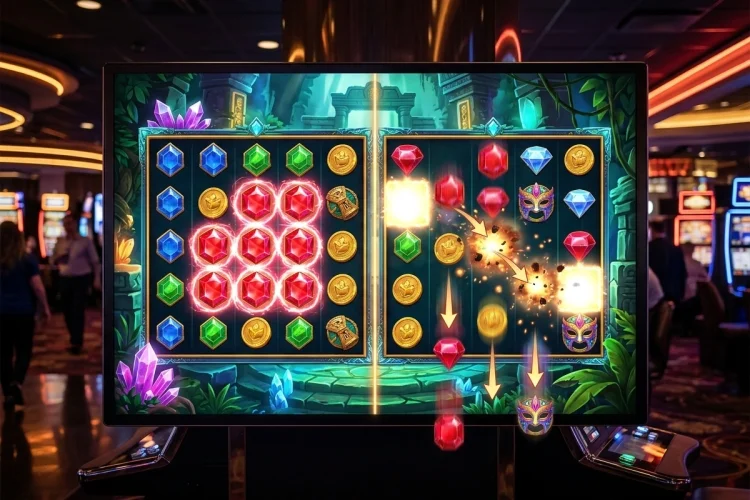
Once a winning combination is paid, the symbols involved are removed. Symbols above them fall into the empty spaces, and new icons enter the grid.

If another winning combination appears, another cascade can begin.

NetEnt calls its version Avalanche. In Gonzo’s Quest, winning symbols on paylines disappear and are replaced by new symbols falling into their positions.

Other developers use names such as tumble, reaction, cascade, or drop.

The terminology changes, but the basic idea is similar.

One paid spin can potentially generate several sequential results before no new win remains.

The Biggest Difference Is Win Formation vs Win Continuation

This is the easiest way to remember the distinction.

Cluster Pays tells the game what counts as a win.

Cascading Reels tell the game what happens after that win.

Suppose a 7×7 grid requires five matching symbols to touch.

That is the Cluster Pays rule.

Now suppose those five symbols disappear after payout and new symbols fall into their spaces.

That is the cascading rule.

They are seperate systems even though they interact closely.

This distinction is important because many modern slots package both mechanics together, making them appear like one feature.

Once you separate them mentally, the paytable becomes much easier to understand.

Cluster Pays Can Work With Cascades

Sugar Rush is a clear example of the two mechanics working together.

Pragmatic Play describes the game as using a 7×7 grid where five or more matching symbols connected horizontally or vertically create a winning cluster. Those winning symbols then disappear through the tumble feature, allowing new symbols to fall into place.

Sugar Rush 1000 follows the same basic structure while adding stronger multiplier spots. Pragmatic Play specifically describes it as combining cluster pays with tumbling gameplay.

So one mechanic determines whether the cluster qualifies.

The second mechanic continues the action afterward.

This combination is popular because clusters can create irregular empty spaces across a large grid, giving replacement symbols many opportunities to form another group.

Cascading Reels Do Not Require Cluster Pays

This is where the difference becomes especially clear.

Gonzo’s Quest uses traditional paylines rather than Cluster Pays.

It has a five-reel, three-row layout with 20 paylines, yet it also uses the Avalanche cascading mechanic. Winning payline symbols disappear and new ones fall into their spaces.

Bonanza offers another example.

Big Time Gaming combines its Megaways system with Dual Reaction, a cascading reel feature. The game can create up to 117,649 ways to win, but its wins are not based on connected clusters.

That proves cascades are independent from Cluster Pays.

They can work with paylines, ways-to-win systems, Megaways, or grid-based cluster games.

The cascade simply needs a rule telling it which symbols should be removed after a win.

Cluster Pays Changes How You Read the Grid

Traditional slots train players to look for repeated symbols across reels.

Cluster games require a different visual habit.

Imagine a 7×7 board filled with candy symbols.

You may see three blue candies in one area and another two directly below them.

If all five are connected horizontally or vertically, they can form one cluster even though they do not sit on a straight line.

Cosmic Clusters uses a 6×6 grid where groups of five to fourteen matching symbols can create wins before triggering tumbles.

This structure makes the grid feel more like a puzzle board.

Diagonal symbols may look connected visually but often do not count unless the game rules specifically allow diagonal contact.

That is why reading the paytable is important before assuming how clusters form.

Cascades Can Create Multiple Wins From One Spin

The appeal of cascading mechanics is continuation.

A normal reel game may finish immediately after the reels stop and the payout is calculated.

A cascading game can continue changing after the initial result.

Suppose your first result produces a 4x payout.

The winning symbols disappear.

Replacement symbols create another 2x result.

Those symbols disappear too, followed by a third 5x combination.

The entire sequence began from one initial wager.

Some games also increase multipliers during those sequences.

Gonzo’s Quest, for example, increases its Avalanche multiplier as consecutive wins occur, up to the stated limits of the game.

That multiplier progression is an additional feature, not something every cascading slot automatically includes.

Cluster Games Often Use Large Grids

Cluster Pays tends to work naturally with larger grids.

A traditional 5×3 layout gives only fifteen symbol positions.

A 7×7 cluster grid contains forty-nine positions, giving connected symbols more room to form different shapes.

Pragmatic Play’s Candy Rush uses a 7×7 tumbling grid where clusters of five to fifteen or more matching symbols can create payouts.

Mining Rush also uses a 7×7 Cluster Pays format combined with tumbling wins.

However, grid size alone does not define Cluster Pays.

A game can use an unusual board shape or smaller layout as long as its payout rule is based on connected symbol groups.

Always check the actual mechanic rather than assuming any large grid must be a cluster game.

Cascades Can Interact With Wilds and Multipliers

Cascades often become the engine that powers additional mechanics.

A developer may add Wild symbols after each winning tumble, increase a multiplier, upgrade special symbols, or leave persistent modifiers behind.

Hot Pepper, for example, uses a 7×7 cluster grid where winning symbols disappear and new ones replace them. The game can also leave multiplier Wilds behind during tumbles.

Mystery Mice uses cluster wins and tumbles while special Power Wilds change as they participate in wins.

These features can make the cascade sequence much more important than the original result.

Still, remember that Wilds and multipliers are seperate mechanics again.

They are additions layered onto the cluster-and-cascade foundation.

Does One Mechanic Offer Better Odds?

Not automatically.

Cluster Pays does not guarantee more frequent wins simply because several symbols can connect in different shapes.

Cascading Reels also do not guarantee that every winning sequence will continue.

The game’s mathematical model determines symbol probability, RTP, volatility, payout values, bonus frequency, and maximum win.

Two cluster games can behave very differently.

Likewise, two cascading slots can have completely different risk profiles.

A busy screen with repeated explosions may feel more active, but visual activity should not be confused with better expected return.

Compare RTP and volatility seperately from the headline mechanic.

The core Cluster Pays vs Cascading Reels difference is simple: Cluster Pays determines how matching symbols form a winning group, while Cascading Reels remove winning symbols and replace them to create possible follow-up wins.

Many modern slots combine both, but neither mechanic requires the other. Check the paytable, cluster size, cascade rules, multipliers, and bonus features before playing.


Best Types of Free Slots for Learning the Basics

Best Types of Free Slots for Learning the Basics

Javier Domínguez09/09/202609/19/2026

Modern slots can look surprisingly complicated when you are new. One game has three reels and five lines, while another throws in hundreds of winning ways, cascades, multipliers, mystery symbols, and several bonus rounds at once.

The Best Types of Free Slots for beginners are usually games that introduce those ideas gradually. Free-play versions let you explore reels, paylines, Wilds, Scatters, Free Spins, and payout tables without risking money.

The key is choosing simple formats first instead of jumping directly into a feature-heavy game where it is difficult to understand what caused each result.

Start With Classic Three-Reel Slots

Classic three-reel games are one of the easiest places to begin.

Their layouts are usually compact, the number of symbols is limited, and winning patterns are easier to follow visually. Instead of watching six moving reels and dozens of modifiers, you can focus on the basic idea of matching symbols according to the paytable.

Yggdrasil’s Extreme Hot Gems is a useful example of the format. It uses three reels and five winlines that pay from left to right, while the developer categorises it as low volatility.

A game like this helps beginners learn three basic questions:

Where does a winning combination start? How many matching symbols are needed? How does the payout change when more symbols match?

Once those ideas feel natural, more complex games become much easier to understand.

Try Fixed-Payline Video Slots Next

After learning a simple three-reel format, move to a five-reel slot with fixed paylines.

Fixed-payline games introduce more possible combinations without completely changing the underlying concept. A payline is simply a predefined route across the reels that can form a qualifying combination.

Some games have 10, 20, 25, or 40 lines.

Pragmatic Play’s Hot to Burn Extreme, for example, uses 40 paylines and a retro-style structure while also adding Free Spins.

Fixed paylines are useful because you can open the paytable and see exactly where winning lines travel across the screen.

Spend some time watching how identical symbols can appear on the reels without necessarily producing a payout. That teaches an important lesson: matching symbols alone are not enough if they are not arranged according to the game’s winning rules.

This is a much clearer begining than immediately experimenting with thousands of ways to win.

Use Low-Volatility Free Slots to Observe Balance Movement

Low-volatility games can also be useful learning tools.

Volatility describes how a game’s payouts tend to be distributed. Lower-volatility titles generally aim for a smoother payout profile than highly volatile games, although individual sessions can still vary significantly.

Yggdrasil’s Hell’s Hogs, for example, is officially categorised as low volatility and uses a familiar 5×3 layout with 20 paylines.

That kind of structure gives you time to watch how ordinary wins, Scatters, and bonus features affect a virtual balance.

Do not use a short demo session to decide that a game always pays frequently. Random sequences can look very diffrent from one session to another.

Instead, use the experience to understand how stake size, winning combinations, and payout amounts interact.

Learn Wild and Scatter Symbols With Simple Bonus Slots

Once paylines make sense, choose a free slot with straightforward Wild and Scatter symbols.

A Wild normally helps complete certain paying combinations, although the exact substitution rules depend on the game.

Scatters frequently trigger bonuses such as Free Spins, but again, every title can apply different conditions.

The advantage of learning these symbols in free play is that you can open the game’s information panel whenever something unfamiliar happens.

Suppose three Scatters trigger ten Free Spins. Watch what changes during the feature.

Do Wilds appear more often? Is there a multiplier? Can extra Scatters retrigger the bonus?

The goal is not simply to wait for the feature. Try to understand why it triggered and how its rules differ from normal play.

This turns free slots into interactive tutorials rather than just entertainment.

Learn Free Spins Before Complex Bonus Systems

Free Spins are among the most common slot features, so they deserve special attention.

Start with a game where the bonus works in a relatively simple way: collect a specified number of Scatters, receive several free rounds, and possibly trigger additional spins.

Once you understand that structure, more advanced versions become easier.

Modern games can attach increasing multipliers, expanding reels, Sticky Wilds, collections, or persistent features to Free Spins.

If you start with all those mechanics at once, it can be difficult to tell whether a large payout came from the symbol value, a Wild, a multiplier, or another modifier.

Free-play mode lets you slow down and read the rules without putting real funds at risk. That educational value is one reason legitimate demo modes are useful.

Under UK Gambling Commission rules, play-for-free games offered alongside their real-money equivalents on the same facility must use the same game rules and should accurately represent winning likelihood and prize distribution.

Move to Ways-to-Win Slots

After fixed paylines feel easy, try a game that uses ways to win.

These games usually remove predefined line shapes. Instead, matching symbols can form qualifying combinations across consecutive reels according to the game’s rules.

This teaches an important difference between paylines and ways.

With paylines, symbol positions generally need to follow specific paths.

With ways-to-win systems, the exact vertical position may not matter as long as the required symbols appear on the appropriate reels.

Start with a relatively simple ways game before attempting something more elaborate.

The purpose is to learn how several copies of the same symbol across multiple reels can create several separate winning combinations.

This concept becomes especially important when you eventually reach Megaways slots.

Try Megaways After the Basics Make Sense

Megaways is better treated as an intermediate lesson than a starting point.

Big Time Gaming’s Megaways system can create up to 117,649 ways to win in many six-reel configurations. Titles such as Fireworks Megaways also combine those changing winning ways with cascading reactions.

That creates several moving parts at once.

The number of visible symbols can change, the number of winning ways can change, and winning symbols may disappear before replacements fall into position.

Free play is particularly useful here because you can watch these processes repeatedly.

Check the ways counter before each spin. Then watch what happens after a winning reaction.

Once you understand fixed paylines first, the contrast becomes much clearer instead of feeling completly random.

Explore Cluster Pays as Another Advanced Format

Cluster slots remove another familiar rule.

Instead of following paylines or consecutive reels, they pay for groups of matching symbols connected on a grid.

Evolution’s Funk Master, for example, uses Cluster Pays, where five or more matching adjacent symbols can create a qualifying cluster. Winning symbols then disappear through its Avalanche mechanic and are replaced.

This is useful for learning how drastically slot mathematics can change while the basic idea of matching symbols remains.

Try cluster games after traditional slots because you will immediately notice what has changed.

You are no longer scanning from left to right.

Instead, you are looking for connected groups across the grid.

That comparison makes free play valuable as an educational tool.

Always Read the Paytable During Free Play

The most useful free slot is not necessarily the one with the flashiest graphics.

It is the one where you actually read the rules.

Open the information panel and look for symbol values, paylines or winning ways, Wild behaviour, Scatter requirements, RTP information, volatility, bonus rules, and maximum payouts.

Then watch how those rules appear during actual demo spins.

Free play should help you connect written rules with visual outcomes.

It should not be used to predict the next result or to assume that a winning demo session means real-money play would produce the same outcome.

The Best Types of Free Slots for learning are simple classics, fixed-payline games, low-volatility titles, and straightforward Free Spins slots before progressing to ways, Megaways, and Cluster Pays.

Use demo mode to understand rules rather than chase results. Start with the simplest format, read each paytable carefully, and move to more advanced mechanics only when the basics feel comfortable.

Compare Two Online Slots with a Simple Scoring Framework

Compare Two Online Slots with a Simple Scoring Framework

Javier Domínguez08/08/202608/05/2026

Comparing two slot games can become surprisingly subjective. A reviewer may prefer one theme, enjoy a particular soundtrack, or give extra credit to the game that happened to produce the biggest demo win.

A scoring framework creates more consistency. When you Compare Two Online Slots using the same categories and weighting, readers can see exactly why one title received a stronger rating.

The score should not suggest that the higher-rated game is more likely to produce a profit. Instead, it should measure transparency, mechanics, presentation, usability, and overall entertainment design.

Here is a practical structure you can reuse across different slot comparisons.

Build the Framework Before Playing

Choose your categories before opening either game. This prevents you from changing the rules to favor the title you already prefer.

A possible framework could assign:

  • 25% to gameplay and mechanics
  • 20% to transparency and mathematical information
  • 15% to bonus features
  • 15% to presentation
  • 15% to technical performance
  • 10% to responsible design

The percentages can be adjusted for your publication, but they should remain identical for both games.

Score Mathematical Transparency

Check whether each title displays its RTP, volatility, stake limits, paytable, maximum win, and feature rules clearly.

RTP should be treated as a long-term theoretical percentage. A short test session cannot confirm or disprove the published figure, and previous wins or losses do not determine the next random outcome.

Award points for clarity and accessibility. Do not award points according to how much the test balance increased.

Rate the Main Gameplay

Examine how winning combinations form and whether the basic spin cycle remains understandable. Look at paylines, payways, clusters, cascades, symbol upgrades, or other central mechanics.

Ask whether the main system feels coherent. A complex game is not automatically superior to a simple one.

For example, a traditional 20-payline slot may appeal to readers who prefer familiar rules, while a pays-anywhere game can offer a busier grid and more varied combinations. Neither approach is universally better.

Judge Features by Their Execution

Review every important wild, scatter, free-spin round, multiplier, respin, or collection feature. Explain the trigger and what changes after activation.

Then score the quality rather than the number of features. Consider whether the rules are easy to understand, whether the mechanic connects naturally with the base game, and whether the interface communicates progress clearly.

A feature that looks impressive in marketing material may add little if it is confusing or disconnected from normal play.

Compare Maximum-Win Information

Record the maximum potential for each game and state whether it is expressed as a multiple of the stake.

Provider pages show how widely these limits can differ. Greedy Wolf advertises a maximum of 3,000x, while Zeus vs Hades lists 15,000x.

Do not automatically award the higher score to the larger number. Also evaluate how clearly the limit is disclosed and whether important conditions are explained in the rules.

Score Presentation Separately

Compare artwork, symbol clarity, animation, music, sound effects, and thematic consistency. Keep technical execution separate from personal taste.

You may dislike a mythology theme but still recognize sharp graphics and readable symbols. Write personal reactions as opinions rather than facts.

Presentation should also communicate results honestly. The interface should make the stake and final return easy to understand.

Test Technical Performance Equally

Use the same phone, browser, connection, and screen orientation for both titles. Record loading speed, lag, touch response, sound behavior, and paytable readability.

Repeat any failed test before reducing a score. A temporary network interruption should not be blamed automatically on the game.

GLI explains that professional evaluations can include game mathematics, RNG testing, award odds, and desktop or mobile behavior. A normal review is more limited, so disclose your conditions clearly.

Explain the Final Result

Show the score for every category instead of publishing only a total. A game might win on visual design but lose on rule clarity or mobile usability.

End by identifying the type of reader each title may suit. This is often more useful than declaring that one game is objectively the best.

A structured framework helps you Compare Two Online Slots without letting temporary results or personal preferences dominate the verdict.

Decide the categories first, verify the mathematical information, examine feature execution, and test both games under equal conditions. Explain every category score and distinguish measurable weaknesses from individual taste.

The higher-rated title should represent the stronger overall product according to your published criteria-not a promise of better financial results.

Create your scoring sheet before the next comparison, save your testing evidence, and apply exactly the same standards to both games from beginning to end.

Modern Slot Game Mechanics: How Touch Interfaces Change Play

Modern Slot Game Mechanics: How Touch Interfaces Change Play

Javier Domínguez07/29/202608/13/2026

A slot designed around a mouse can technically run on a smartphone, but that does not mean it feels right. A cursor can accurately select a tiny icon, hover over controls, and move across a large screen. A finger is less precise, temporarily covers whatever it touches, and usually operates inside a much smaller display.

That difference has influenced Modern Slot Game Mechanics in ways that go beyond simply enlarging the Spin button. Touch-first interfaces affect how features are activated, how betting controls are organised, how bonus information appears, and how quickly the game responds to input.

Apple recommends designing games to embrace touchscreen interaction, while web standards provide dedicated pointer and touch technologies for handling fingers alongside mice and styluses.

Mobile design has therefore become part of the mechanic itself, not just the presentation layer.

Touchscreens Push Core Actions Toward Simple Taps

Desktop games can comfortably support small controls spread around the interface.

Touchscreens reward simpler interaction.

For slot design, that usually means important actions such as Spin, Bet, information, sound, and feature selection need obvious touch targets rather than controls that depend on precise cursor placement.

Apple recommends touch controls that are at least 44 by 44 points, while WCAG 2.2 sets a 24 by 24 CSS-pixel minimum target size for pointer inputs in applicable web accessibility scenarios.

That physical requirement can influence the entire control layout.

A large Spin button occupies considerably more screen space than a small desktop button. Bet adjustment may therefore move into a separate panel, while secondary settings are grouped behind a menu.

The mechanic remains the same mathematically, but its interation pattern changes.

Gesture Input Can Become Part of Feature Design

Touchscreens provide something a traditional mouse interface does not naturally emphasise: gestures.

Developers can detect taps, swipes, multiple simultaneous touch points, and more complex actions through technologies such as Pointer Events. MDN describes Pointer Events as a device-independent input model that can support mouse, stylus, and touchscreen interaction, including multiple active pointers.

That creates opportunities for game mechanics.

A bonus feature might allow the player to tap one of several mystery objects. Another could let users swipe between feature options or tap positions on a prize wheel.

However, gestures should add convenience rather than become unnecessary obstacles.

W3C accessibility guidance says functionality that relies on dragging should generally provide a single-pointer alternative when dragging is not essential.

So if a player can drag a slider to select a stake, allowing taps on the slider or separate plus-and-minus controls can make the mechanic easier to operate.

Screen Size Changes How Features Are Revealed

Desktop slot interfaces can display a lot at once.

A large monitor might show the reels, paytable shortcut, current bet, balance, autoplay settings, jackpot information, and several feature meters simultaneously.

A smartphone cannot comfortably give everything equal priority.

Touch-first design therefore encourages progressive disclosure: show the controls needed now, then reveal secondary options when requested.

For example, a feature-buy or bonus-selection interface may open as a full-screen layer rather than squeezing five choices underneath the reels.

This can change how a mechanic is experienced.

Instead of reading several options while continuing to watch the grid, the player enters a clearly defined decision state.

The underlying probabilities do not have to change. The responsivness of the interface simply makes the state transition more obvious.

Thumb Reach Influences Control Hierarchy

Most smartphone interaction happens with fingers approaching the display from below or from one side.

That gives certain screen regions more practical importance than others.

Game designers therefore tend to keep frequently used controls accessible while moving less frequent settings away from the central interaction area.

The Spin button is an obvious example.

If it were placed as a tiny control in a top corner, repeatedly activating it could be uncomfortable. A larger lower-screen control is easier to reach while leaving the reel area visible.

Apple’s broader game-design guidance encourages touch controls that work naturally with touchscreen interaction rather than merely reproducing controls designed for another input device.

This hierarchy can also affect mechanics such as turbo modes, bet selection, and feature choices.

Actions requiring repeated input benefit most from highly accessible positioning.

Immediate Feedback Becomes Part of the Mechanic

With a mouse, users can often see hover states before clicking.

A touchscreen normally has no persistent hover cursor.

The interface therefore needs to confirm input immediately after the finger touches the screen.

A button may depress visually, animate, vibrate where supported, or change state before the larger game animation begins.

This feedback is especially important in slot interfaces because an unclear tap can lead players to touch the control again. If the first tap was already registered, an accidental second interaction may follow.

Browser-based games can handle pointer-down and pointer-up states directly through Pointer Events, allowing interfaces to respond throughout the touch lifecycle.

The result is a subtle change in mechanic design: acknowledgement becomes part of the action itself.

A spin should not merely start. The interface should make it obvious that the request has been received.

Animation Timing Must Keep Up With Input

Touch design also exposes latency quickly.

When users directly touch a screen element, they expect it to react almost immediately. A noticeable delay between tapping Spin and seeing visual feedback can make the interface feel disconnected.

For browser games, requestAnimationFrame() allows animation updates to be coordinated with browser repaint cycles and generally follows the display refresh rate. MDN notes that common screens may operate at 60Hz while higher-refresh displays such as 120Hz are also widespread.

Modern slot interfaces therefore need animation systems that respond smoothly across different refresh rates.

That includes reel acceleration, button feedback, expanding symbols, counters, and bonus transitions.

The goal is not simply maximum frame rate.

Consistent timing makes touch interaction feel direct. Poor timing makes the player feel as though the interface is reacting after their finger rather than with it.

Touch Can Simplify Complex Bonus Mechanics

One interesting effect of mobile design is that complicated mechanics often need simpler interaction.

Imagine a bonus containing six upgrade paths and multiple configuration options.

On desktop, all six might appear simultaneously with descriptions beside them.

On mobile, that can become visually crowded.

A touch-first version might present large selectable cards, allow one tap to open more information, and use another clear button to confirm the choice.

This does not reduce the mathematical complexity of the bonus.

It reduces the interaction complexity.

Unity supports touchscreen input as a dedicated input source on mobile devices, and its current Web documentation also recognises touchscreen input among supported web input types.

Designers can therefore build mechanics around direct selection rather than treating touch as a simulated mouse click.

That distinction often makes mobile bonus systems feel more natural.

Accessibility Changes Good Touch Mechanics for Everyone

Touch design is also closely connected to accessibility.

Small adjacent controls can be difficult for anyone to activate accurately, especially on a moving device. The challenge is greater for users with motor impairments or reduced dexterity.

W3C notes that a finger is larger and less precise than a mouse pointer and provides target-size requirements and guidance intended to reduce accidental activation.

For slot interfaces, this supports several practical choices: larger controls, greater spacing, clear confirmation states, and alternatives to complicated gestures.

A swipe-only feature, for instance, may benefit from visible buttons that perform the same action.

This improves accesibility, but it can also improve the experience for everyone using the game one-handed, on a small screen, or while the device is moving.

Good touch mechanics usually reduce friction rather than add novelty for its own sake.

Touch Design Changes Interaction, Not Random Mathematics

There is an important boundary.

Moving the Spin button, increasing its size, or replacing a desktop menu with touch cards does not inherently alter RTP, symbol weighting, or RNG probabilities.

Those belong to the game’s mathematical model.

Touch interface design changes how players access and understand the mechanics.

A bonus wheel may be activated by tapping rather than clicking. A feature choice may use swipeable cards instead of desktop tabs. The result-selection mathematics can remain exactly the same.

This distinction matters because visually dramatic interaction should not be mistaken for greater control over random outcomes.

The user is controlling the interface.

The certified game logic still determines the result according to its underlying rules.

Modern Slot Game Mechanics increasingly reflect the realities of touchscreen play. Larger targets, direct taps, simpler feature selection, fast feedback, gesture alternatives, and mobile layouts all change how mechanics are experienced without necessarily changing their mathematics.

When evaluating mobile slot design, look beyond responsive graphics and ask whether every feature actually feels natural under a finger. That is where effective touch-first design becomes visible.

Free Spins Bonus Round Mechanics: Triggers, Wilds, and Payouts

Free Spins Bonus Round Mechanics: Triggers, Wilds, and Payouts

Javier Domínguez06/21/202608/05/2026

Free spins often look like a straightforward reward: activate the feature, receive several rounds, and collect whatever the reels produce.

Behind the animation, however, the game is tracking the triggering stake, symbol probabilities, feature modifiers, and total payout. A Free Spins Bonus Round can behave differently from the slot’s normal mode.

Wild symbols may become sticky, multipliers may increase after each win, and the reel grid may expand as the feature progresses.

Understanding these mechanics helps players see why ten spins in one game may work very differently from ten in another.

The headline number alone says little about the potential result because the real value depends on the complete mathematical model.

The Triggering Bet Sets the Value

Most slots preserve the wager used to activate the feature. A bonus triggered at $0.40 usually calculates all associated payouts from that stake.

The game generally does not allow the player to change the bet during the feature. This keeps the prize calculation connected to the paid round that unlocked it.

Check whether the game uses the total stake, line bet, coin value, or another measurement when displaying multipliers.

Scatter Symbols Commonly Start the Round

Scatters often activate free spins when three or more land anywhere on the visible grid. Unlike ordinary symbols, they may not need to appear on one active payline.

A typical structure might award ten spins for three scatters, fifteen for four, and twenty for five. Some slots also pay an immediate scatter prize.

Bonus triggers and their rules should be clearly explained in the game information before a wager is made.

Wild Symbols Can Gain Extra Powers

A regular wild normally replaces selected standard symbols. During free spins, it may expand across a reel, move to a new position, or remain sticky for several rounds.

Some wilds carry multipliers. A winning line containing a 2× wild and a 3× wild might produce a combined multiplier, although the exact calculation depends on the rules.

These enhanced symbols can improve potential payouts, but they do not guarantee that a qualifying combination will appear.

Multipliers May Stay Fixed or Grow

A fixed multiplier applies the same value throughout the bonus. For example, every qualifying payout could be doubled.

Progressive multipliers increase during the round. A cascading slot might begin at 1×, rise to 2× after one win, and continue growing when consecutive cascades occur.

Suppose a symbol combination pays $4 while a 5× multiplier is active:

$4 × 5 = $20

The multiplier may reset on the next spin, remain active, or continue increasing. Always check the feature rules.

Retriggers Extend the Feature

Retriggers provide extra rounds when another qualifying symbol combination appears. They can significantly extend the feature, especially when no strict maximum applies.

However, more spins do not automatically mean more money. Ten additional rounds could produce several payouts, one small return, or no qualifying wins.

The remaining spin count and any applicable limits should be visible or explained in the help section.

How the Final Payout Is Totalled

The game adds together every eligible prize earned during the feature. The combined amount is normally displayed at the end and then transferred to the player’s balance.

Imagine five winning spins paying $2, $0.50, $4, $1, and $7.50. The total bonus payout would be $15.

That figure should still be compared with the total amount spent during the wider session. A $15 bonus does not represent an overall profit when considerably more was wagered before it appeared.

Why Bonus Results Vary So Much

The feature uses random outcomes generated according to the slot’s approved mathematical model. RNG certification is intended to verify that outcomes are unpredictable and do not contain unfair bias.

Volatility also matters. One game may distribute feature value through frequent small wins, while another concentrates more of it in rare multiplier combinations.

Testing laboratories use theoretical evaluation or large simulations to examine pay combinations and feature contributions to RTP.

Free-spin mechanics combine the triggering stake with special rules such as enhanced wilds, growing multipliers, retriggers, and changing reel layouts.

These features determine how bonus prizes are calculated, but they cannot guarantee that the final payout will exceed the amount previously spent.

Before starting a slot, read how its scatters work, what value each multiplier uses, and whether retriggers have a limit.

Pay attention to the final balance rather than dramatic animations or the number of awarded spins. Treat the feature as part of a random entertainment game, use only an affordable budget, and stop when your planned limit is reached.

Spotlight

  • Best Types of Free Slots for Learning the BasicsBest Types of Free Slots for Learning the Basics
  • What Happens After a Progressive Jackpot Is Won? A Simple GuideWhat Happens After a Progressive Jackpot Is Won? A Simple Guide
  • Virtual Credit Systems in Free Slot Modes: How Demo Balances WorkVirtual Credit Systems in Free Slot Modes: How Demo Balances Work
  • Progressive Jackpot Systems: How Seed Values Shape Every ResetProgressive Jackpot Systems: How Seed Values Shape Every Reset
Explore the technologies shaping modern life through clear, engaging coverage of gadgets, software, artificial intelligence, cybersecurity, mobile devices, apps, and digital innovation. Our technology content explains important developments, examines emerging trends, and provides practical insights that help readers better understand the tools, platforms, and ideas transforming the digital world today.
Find What You Need
See What’s Available
Check What’s Available
Explore What’s Available
Discover What’s Available
See How It Works
Learn How It Works
Discover How It Works
Find Out How
See How
Learn More About It
Find Out More About It
Discover More About It
Explore More About It
Read More About It
Get the Details
Get Full Details
Get the Full Story
View the Full Story
Discover the Full Story
Explore the Full Story
Find the Full Story
Learn More Now
Find Out Now
Read More Now
View More Now
See More Now
Get Started Now
Start Exploring
Start Discovering
Start Learning
Explore Here
Discover Here
Read It Here
See It Here
View It Here
Check It Here
Find It Here
Go Here
Visit Here
Click to Explore
Click to Discover
Click to Read More
Click to View
Click to See More
Click for Details
Click for More Information
Tap to Learn More
Tap to Explore
Tap to Discover
Take Me There
Show Me More
Tell Me More
Show Me the Details
See the Benefits
Discover the Benefits
Explore the Benefits
Find Out Why
See Why
Discover Why

Latest Updates

  • Push Gaming Slots: Features and Game Design ExplainedPush Gaming Slots: Features and Game Design Explained
  • Cluster Pays vs Cascading Reels: What Is the Difference?Cluster Pays vs Cascading Reels: What Is the Difference?
  • iPhone Slots Guide: Safari, Apps and Compatibility ExplainediPhone Slots Guide: Safari, Apps and Compatibility Explained
  • Best Types of Free Slots for Learning the BasicsBest Types of Free Slots for Learning the Basics
  • About Us
  • Contact
  • Disclaimer
  • Privacy Policy
  • Terms & Conditions
© 2026 YukonBlondeStream.com | Theme: BlockWP by Candid Themes.