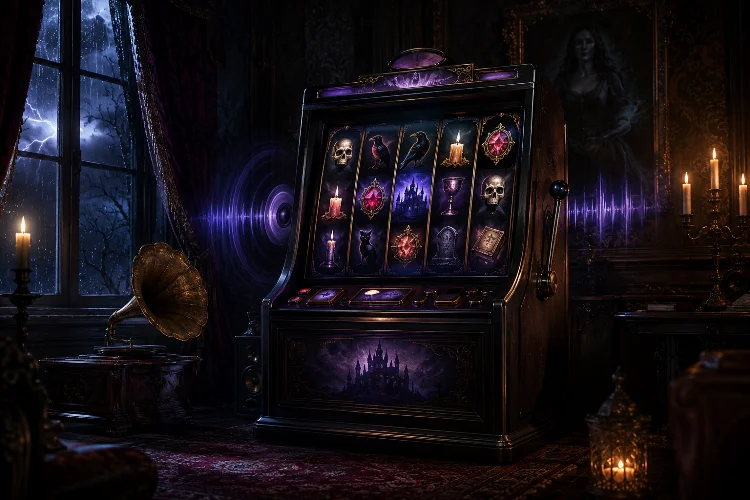
A haunted mansion can look creepy on screen, but remove the sound and much of the tension disappears. No creaking doors, distant thunder, whispered voices, or sudden musical hit means the same artwork can quickly feel surprisingly ordinary.
That is why Horror-Themed Slots rely heavily on audio design. Music, ambient noise, silence, character voices, and feature sounds work together to establish mood before anything dramatic even happens.
Research into virtual threat environments has shown that ambient audio can help create a growing sense of dread while individual sounds can suggest that something unseen is nearby.
Slot games operate in a much simpler interactive format, but the same basic design principle applies: sound can tell the player what kind of world they have entered before the reels explain anything.
Ambient Sound Builds the World Before the Spin
Good horror audio often begins quietly.
Wind may move through an abandoned building. A clock ticks somewhere in the background. Chains scrape occasionally, while low-frequency drones sit underneath the music.
None of these sounds needs to represent a feature.
Their main purpose is environmental.
Research into fear-focused virtual environments identifies environmental design as an important component in creating negative emotional responses and atmosphere. Audio helps make that visual enviroment feel less like a static background and more like a place.
A vampire-themed slot, for example, might combine distant wolves, storm ambience, and subtle organ music.
A zombie game could use radio static, sirens, or distant impacts.
These details establish genre immediately without filling the screen with explanatory text.
Silence Can Be More Effective Than Constant Noise
Horror does not always need louder sound.
Sometimes removing sound creates more tension.
Imagine the reels normally spin over a continuous dark soundtrack. Just before a feature activates, most of that audio suddenly disappears.
The player’s attention increases because the normal pattern has changed.
Then a single heartbeat, whisper, bell, or impact sound arrives.
Research into jump scares breaks the effect into stages including a baseline, anticipation, sudden arrival or “stinger,” and a return toward baseline. That structure helps explain why contrast matters so much.
If everything is loud, nothing feels surprising.
If the audio design creates space before an important moment, even a short sound can feel much more dramatic.
For slot designers, the useful lesson is not to add constant screaming or heavy music. It is to control when the game becomes loud.
That timing makes the audio feel more deliberate.
Music Can Signal Different Game States
Slot games frequently move between several states.
There is the normal base game, an anticipation sequence, a bonus trigger, free spins, and sometimes a final feature or multiplier stage.
Music can tell the player which state is active.
The base game might use a slow atmospheric loop. When two scatters appear, another musical layer can enter. During free spins, the tempo may increase and the instrumentation become heavier.
Play’n GO’s horror catalogue shows how strongly some slot experiences are built around music. Its Lordi Reel Monsters incorporates music from the band and lets the Free Spins feature use selectable Lordi songs, while the company describes animated characters and eerie audio as part of its spooky-game presentation.
This makes music functional as well as decorative.
A soundtrack change can communicate:
something different is happening now.
Players may understand that transition before they even read a bonus message.
Sound Effects Can Explain Mechanics
Audio can also operate like interface feedback.
A sticky wild locking into place needs a sound that communicates permanence.
A multiplier increasing needs another cue.
A transforming symbol should sound different from an ordinary symbol landing.
These audio signatures help users connect action with consequence.
Think of a vampire turning into a bat. Animation explains the transformation visually, but a wing-flap, supernatural sweep, or impact sound reinforces that something mechanically important occurred.
Play’n GO’s Count Jokula uses a transforming vampire theme alongside shapeshifting and respin mechanics, demonstrating how a horror character can become directly connected with feature behaviour.
The exact mathematical result remains determined by the game.
Sound simply makes the transition easier to recognise.
That distinction is important. Audio should clarify the mechanic rather than imply a guaranteed outcome that does not exist.
Anticipation Audio Needs Careful Timing
Few slot sounds are more recognisable than the rising audio that appears when a potential bonus is close to forming.
Two scatters land.
The remaining reels keep moving.
Music rises.
The final reel slows.
This is an anticipation sequence.
Horror themes can push this technique further through heartbeats, breathing, distorted voices, or increasingly intense orchestration.
The effect works because players hear that the interface has entered a special state.
Research into recreational horror suggests that enjoyment does not simply increase endlessly with fear; one field study found an inverted-U relationship where enjoyment peaked around a certain balance of fear rather than at maximum intensity.
That idea offers a useful design lesson.
If every spin uses extreme tension, the effect becomes exhausting and repetative.
Anticipation works better when contrasted with quieter periods.
Horror Characters Become Stronger With Voice and Motion
Characters are often central to horror-themed games.
Vampires whisper.
Ghosts laugh.
Monsters roar.
A mysterious narrator may speak before a bonus begins.
Play’n GO’s Wild Blood 2 places several vampire characters inside a haunted-mansion story, with individual characters connected to different powers during the game’s feature structure.
Sound helps those characters feel present.
Without audio, a vampire portrait appearing beside the reels remains largely visual decoration.
Add a short voice line, transformation noise, and animated movement, and the same character suddenly becomes part of the feature communication system.
This does not require long dialogue.
A one-second vocal reaction can be enough.
The goal is to make characters feel responsive without interrupting the flow of the game.
Animation and Audio Work Best When Synchronised
Animation becomes much more convincing when sound arrives at exactly the right moment.
Imagine lightning hitting a reel.
If the thunder plays half a second before the visual impact, the effect feels wrong.
If it arrives precisely with the flash, the event feels heavier.
The same principle works with slamming doors, symbol transformations, exploding objects, expanding wilds, and monster appearances.
Multimodal research generally recognises that audio and visual information work together when conveying emotional content. For game designers, that means audiovisual timing deserves as much attention as the individual assets.
A horror feature might follow a simple sequence:
The screen darkens.
A character appears.
The background music drops.
A sharp sound hits exactly as the wild expands.
Then the soundtrack returns in a more intense form.
Every component reinforces the same event.
Poorly syncronised effects can make an expensive animation feel cheap. Strong synchronization makes relatively simple visuals feel much more polished.
Atmosphere Should Support the Game, Not Hide It
Horror presentation can easily become too aggressive.
Dark screens may reduce readability.
Heavy music can hide useful interface sounds.
Large animated monsters may obscure the reels.
Constant effects can also make important moments harder to identify because everything competes for attention.
The strongest Horror-Themed Slots usually treat atmosphere as a layer around the game rather than a replacement for usability.
Players should still be able to identify symbols, understand feature changes, read balances, and recognise what happened after each result.
Atmosphere works best when sound and animation guide attention.
A whisper creates expectation.
A short silence creates focus.
An impact sound confirms a feature.
A soundtrack change marks a new mode.
Once every element has a clear role, horror becomes part of the interface rather than simply decorative noise.
Horror-Themed Slots build atmosphere most effectively when audio does more than play spooky music in the background. Ambience establishes the world, silence creates contrast, stingers mark dramatic events, and synchronized animation makes features easier to understand.
When reviewing a horror slot, listen to how the sound changes between normal spins and important features—the strongest designs make every audio cue feel purposeful.